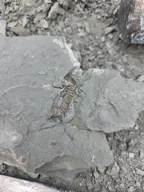
A Late Ordovician seafloor, preserved through repeated burial.
The Mt. Orab butter shale is a thin fossil-bearing
interval within the Sunset Member. Its articulated fossils record several events,
not one frozen moment for the entire bed.
AI-generated narration using a cloned voice. Playback is optional.
Full transcript
Where the Mount Orab bed fits
Hey, I'm Paleo Beard. I want to talk about the Arnheim Formation at Mount Orab, Ohio, and why this particular bit of rock is so interesting. The complete trilobites are an obvious place to start. But the explanation for that preservation is in the sediment around them, and in how the layers fit together.
Mount Orab is in Brown County, Ohio. The rocks we're discussing are Late Ordovician, in the interval called the Richmondian. They preserve evidence of a marine environment: a seafloor with animals living on or around it, and sediment that became part of their fossil record.
The Mount Orab butter shale is an informal bed within the Sunset Member of the Arnheim Formation. Those names describe different levels of the rock sequence. The formation is the larger unit. The member is a subdivision, and the butter shale is a particular interval within that member. Calling it butter shale doesn't make it a separate formation.
The main research behind this explanation is the Mount Orab study by Hunda, Hughes and Flessa, published in 2006. The interval they studied was approximately zero point four six meters thick. That's a measurement of the studied interval, not the thickness of the entire Arnheim Formation.
It's worth holding onto that distinction. What researchers found in this interval tells us about this part of the sequence. We shouldn't stretch every observation into a statement about the whole formation.
And even within that thin interval, the layers don't represent one single moment. There are repeated deposits with different fossil preservation. So rather than picturing one disaster that explains every fossil, we're looking at a succession of burial events recorded in the rock.
Repeated storms, different layers
The studied interval contains at least seven recognizable clay-silt couplets. A couplet is a pair of layers, and these are interpreted as stacked storm-generated event beds. The important part is that burial happened more than once. Sediment from one event was followed by sediment from another, building the sequence that researchers examined.
The basal silt portions contain more transported skeletal debris and separated trilobite parts. The research describes these assemblages as locally transported. That doesn't mean every piece traveled a great distance. It means the remains weren't necessarily buried in exactly the place where the animals had lived.
The research summary also describes scoured bases and ripple cross-lamination in the silt. Those sedimentary features sit alongside the evidence from the fossils. The interpretation isn't based only on whether a trilobite looks complete. It's based on the layers and their contents together.
The clay-rich portions give a different picture. They preserve more articulated remains, meaning parts that are still connected. These assemblages are interpreted as largely in place, with organisms rapidly buried at or near where they lived.
That contrast is inside the butter-shale interval. It's not a general rule that every shale preserves animals one way and every limestone preserves them another way. Here, the useful comparison is between the clay-rich and silt-rich portions of the event beds.
What interests me is how much the surrounding sediment changes the question. Instead of only asking whether a fossil is complete, we can ask whether its remains were moved, whether they came apart, and how quickly they were covered. The clay and silt don't give identical answers. Keeping those records separate helps preserve what the sequence is actually telling us.
The animals, and what their remains record
There's more to the documented Mount Orab community than trilobites, although they're a particularly well-studied part of it. Flexicalymene retrorsa is the characteristic named trilobite in the bed. Isotelus is also recorded, at genus level. The published fauna includes crinoids, bryozoans and bivalves, including the genus Modiolopsis.
Lingulids are reported too. Leaving a group out of a short explanation isn't the same as saying it wasn't there. The point isn't to turn this into a long roll call. It's that the bed records a community, not just one kind of animal.
There's also Chondrites, which is a burrow trace. That distinction matters: a trace fossil records activity in the sediment. It isn't the name of an identified body-fossil animal. The record includes both remains of organisms and evidence of activity around them.
Among the trilobites, there are enrolled specimens, prone specimens, and individuals partway between. In ordinary language, some are curled up, some are stretched out, and some are partly curled. There are carcasses, molts and disarticulated remains as well. A molt is an outer skeleton shed by the animal. So not every preserved trilobite skeleton represents a death at that spot.
That's one reason to be careful about a fossil's pose. Enrollment alone doesn't establish how an individual died. A curled-up specimen doesn't give us a complete account of its final moments.
The study found no strong evidence for one reproductive or molting aggregation explaining the assemblage. There are different kinds of remains and different preservation histories to account for. I think that's more useful than choosing one simple story and trying to make every fossil fit it. The evidence lets us say quite a bit, without pretending it answers everything.
How much of the past can this bed show us?
This brings us to taphonomy. It's the part of the story concerned with what happened to remains on their way into the fossil record. In the Mount Orab study, that means looking at preservation, movement, burial and the way different layers record different histories.
A rapidly buried clay-layer assemblage can give a relatively close view of a seafloor community. But the entire studied interval combines multiple events. Those are different scales of observation. Fossils from separate layers shouldn't automatically be treated as animals that were all buried together.
That's why the layer record matters so much. A formation name places material in a broad geological unit. A more precise position in the sequence connects it to the clay, the silt, and the evidence for a particular depositional setting. If that position is lost, some of the useful context is lost with it.
The same care applies to the community record. A fossil reported elsewhere in the Arnheim Formation doesn't automatically become part of the documented Mount Orab bed fauna. The formation-wide record and the locality record answer different questions. Neither needs to be exaggerated to be interesting.
And traces of injury have limits too. Healed damage or a supposed bite mark doesn't, by itself, identify a predator or prove that a cephalopod was present. A body-fossil fauna list needs body-fossil evidence, not just an appealing explanation for a damaged shell.
For me, the remarkable thing is how these observations work together. The sediment records repeated deposition. The fossils record different degrees of articulation and movement. Together, they support an interpretation of repeated storm burial without turning the whole bed into one frozen instant.
Thanks for hanging out. I'm Paleo Beard, and that's why the layers around the fossils deserve some attention too.
Stratigraphy
The studied interval
Age
Late Ordovician — Richmondian
Member
Sunset Member
Locality
Mount Orab, Brown County, Ohio, USA
Studied thickness
Approximately 0.46 m in the studied interval
Event beds
At least seven recognizable clay-silt couplets
Sediment
Repeated clay-silt couplets within the butter-shale interval
The approximately 0.46 m measurement describes the studied Mt. Orab interval,
not the thickness of the entire Arnheim Formation or a measurement of every Flat Run exposure.
Rapid burial, repeated
The interval contains at least seven recognizable clay-silt couplets interpreted
as stacked storm-generated event beds. More than one depositional event contributed
to the assemblage.
Silt: locally transported remains
The basal silt portions include transported skeletal debris and disarticulated
trilobite remains. These are interpreted as parautochthonous: moved locally rather
than necessarily buried exactly where they lived.
Clay: more articulated remains
The clay-rich portions preserve articulated enrolled, prone and partially enrolled
trilobites, alongside carcasses and molts. They are interpreted as largely autochthonous:
organisms rapidly buried at or near where they lived. Enrolment alone does not establish
how an individual died.
Fauna / Field record
Arnheim fauna checklist
Documented fauna, comparison records and what I’ve personally found.
A checked box means I’ve personally found it. An unchecked box means I haven’t recorded a personal find here, not absence from the formation. These are read-only field-record markers, not visitor checkboxes or stock indicators.
This is a working selection, not an exhaustive census. Formation-wide records are not automatically Mt. Orab or Flat Run records. Occurrence evidence is stated separately on each entry; my personal identification is not being attributed to a paper that only identifies the genus.
Photographs show my published finds, not an independent verification of their species identification. Each photograph links to its record and recorded confidence.
Flexicalymene retrorsa
Personally found
Trilobite · Calymenidae · Mt. Orab bed documented
I’ve personally found Flexicalymene retrorsa, which is also documented from the Mt. Orab bed. I record the identification and provenance of each specimen separately.
My photographed find · PB-2026-000016 Field · Confidence: high
Trilobite · Asaphidae · Formation-wide record; personal Mt. Orab find
I’ve personally found I. maximus at my home quarry. The UGA reference includes the Arnheim in its occurrence range. The Mt. Orab taphonomy paper records Isotelus at genus level; I’m not using that paper to establish the species of my find.
Echinoderm · crinoid · My Arnheim find — my identification
I’ve found stems I identify as Cincinnaticrinus. I’m recording them at genus level, without assigning a species. The Mt. Orab paper supports crinoid occurrence generally, not my identification of these stems.
Echinoderm · crinoid · My Arnheim find — my identification
I identify the calyx I found as Pycnocrinus dyeri. An Arnheim specimen in the Geneseo collection is catalogued as Glyptocrinus dyeri, an alternative combination encountered in collection records. The UGA reference treats Pycnocrinus and Glyptocrinus as distinct genera; the names are not generally interchangeable. I count this as one find, not two.
I’ve personally found bryozoans. Bryozoa is the broad group; narrower genus entries are identifications within that group, not a count of additional specimens.
I’ve personally found Heterotrypa. PBDB collection 192315 also records this genus, citing Key and colleagues (2010); my identification is recorded separately from that reference.
I’ve personally found Chondrites. This is a burrow trace, not the name of an identified body-fossil animal, and is kept separate from body-fossil species.
Trilobite · Cheiruridae · Formation-wide Arnheim record
The UGA occurrence compilation includes the Arnheim, citing Ludvigsen (1977) and Babcock (1996). This does not establish a Flat Run or butter-shale occurrence.
Mollusc · gastropod · Formation-wide Arnheim record
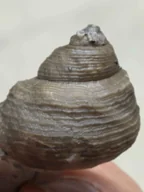
I’ve personally found Cyclonema bilix. The cited compilation includes the Arnheim; my home-quarry identification is my own record, not a claim made by that reference.
My photographed find · PB-2026-000008 After preparation · Confidence: high
Mollusc · gastropod · Formation-wide Arnheim record
I’ve personally found Cyclonema humerosum. It is also listed from the Arnheim and other Cincinnatian units; the published range and my find remain separate records.
Echinoderm · edrioasteroid · Formation-wide Arnheim record
An attached echinoderm included in the Arnheim occurrence compilation. This is not a crinoid, and my crinoid finds do not establish that I’ve found this animal.
Mollusc · nautiloid cephalopod · Formation-wide Arnheim record, genus only
I’ve personally found Treptoceras sp. I retain the genus-level identification without assigning a species. The compilation independently includes an Arnheim record at genus level.
The UGA compilation lists an Arnheim occurrence from Dalvé (1948), but explicitly questions the validity of this species. I include it as a qualified historical record, not as an identification of my crinoid material.
Trilobite · Asaphidae · My Arnheim find — my identification
I’ve personally found Isotelus gigas. This is my specimen identification. The UGA reference lists the species but supplies no occurrence range, so I am not citing it as confirmation of my locality record.
Trilobite · Lichidae · Arnheim occurrence I can confirm — fragments
I can confirm Allolichas fragments from the Arnheim, but I’m not marking them as a personal find. I use the species spelling given by Dry Dredgers; that overview does not establish the formation or identify these fragments to species.
Published Mt. Orab records and fossils I’ve personally found.
Each entry distinguishes the reference evidence from my own identification.
Flexicalymene retrorsa
Trilobite · Calymenidae
The characteristic named trilobite of the Mt. Orab Lagerstätte. Enrolled, prone and partially enrolled individuals occur alongside carcasses, molts and disarticulated remains.
Isotelus sp.
Trilobite · Asaphidae
Documented at genus level. Assigning I. maximus or I. gigas requires diagnostic specimen morphology; locality alone does not establish the species.
Crinoidea indet.
Crinoids
Crinoids are documented in the Mt. Orab fauna. Isolated stems and columnals do not by themselves establish a species identification.
Modiolopsis
Bivalve
Documented at genus level in the Mt. Orab faunal assemblage.
Bryozoa
Bryozoans
Documented colonial animals in the Mt. Orab community; species names require additional evidence.
Chondrites
Trace fossil
A burrow trace recorded in the event beds, not the name of an identified body fossil.
Isotelus maximus
Trilobite · Asaphidae
I’ve personally found I. maximus at my home quarry. The UGA reference includes the Arnheim in its occurrence range. The Mt. Orab taphonomy paper records Isotelus at genus level; I’m not using that paper to establish the species of my find.
Cincinnaticrinus sp. — stems
Echinoderm · crinoid
I’ve found stems I identify as Cincinnaticrinus. I’m recording them at genus level, without assigning a species. The Mt. Orab paper supports crinoid occurrence generally, not my identification of these stems.
Pycnocrinus dyeri — calyx
Echinoderm · crinoid
I identify the calyx I found as Pycnocrinus dyeri. An Arnheim specimen in the Geneseo collection is catalogued as Glyptocrinus dyeri, an alternative combination encountered in collection records. The UGA reference treats Pycnocrinus and Glyptocrinus as distinct genera; the names are not generally interchangeable. I count this as one find, not two.
Modiolopsis sp.
Mollusc · bivalve
I’ve personally found Modiolopsis sp. Recorded at genus level in the Mt. Orab assemblage and in my checklist.
Bryozoans (Bryozoa)
Colonial invertebrates
I’ve personally found bryozoans. Bryozoa is the broad group; narrower genus entries are identifications within that group, not a count of additional specimens.
Heterotrypa
Bryozoan
I’ve personally found Heterotrypa. PBDB collection 192315 also records this genus, citing Key and colleagues (2010); my identification is recorded separately from that reference.
Cyclonema bilix
Mollusc · gastropod
I’ve personally found Cyclonema bilix. The cited compilation includes the Arnheim; my home-quarry identification is my own record, not a claim made by that reference.
Cyclonema humerosum
Mollusc · gastropod
I’ve personally found Cyclonema humerosum. It is also listed from the Arnheim and other Cincinnatian units; the published range and my find remain separate records.
Treptoceras sp.
Mollusc · nautiloid cephalopod
I’ve personally found Treptoceras sp. I retain the genus-level identification without assigning a species. The compilation independently includes an Arnheim record at genus level.
Arnheimograptus anacanthus
Graptolite
I’ve personally found Arnheimograptus anacanthus. The reference lists it from the Arnheim and notes the older combination Glyptograptus anacanthus.
Isotelus gigas
Trilobite · Asaphidae
I’ve personally found Isotelus gigas. This is my specimen identification. The UGA reference lists the species but supplies no occurrence range, so I am not citing it as confirmation of my locality record.
Lingulids are also reported. Brachiopods
are outside this guide’s main focus, not absent from the assemblage.
Formation-wide and regional evidence
Not yet confirmed in my finds
These remaining comparisons are not marked as personal finds. Fossils I’ve
found appear in the checklist and confirmed list above.
An Arnheim or Cincinnatian record alone is not a butter-shale record.
Platyceratid gastropods
An Arnheim crinoid association is reported in the research draft. That does not establish a Flat Run butter-shale occurrence or a species identification.
Additional orthoconic nautiloid identifications
Other undiagnosed straight-shelled material remains at indeterminate genus; I do not automatically call it Orthoceras or assign it to a genus based on locality alone.
Other possibilities under study
Cyclora, Trepospira, Glyptocrinus, Xenocrinus, Cupulocrinus, Ectenocrinus and rare trilobites such as Ceraurus remain comparative possibilities, not a confirmed Flat Run fauna list.
Cephalopod presence must not be inferred solely from healed injuries or bite marks;
a fauna list needs body-fossil evidence.
Name only what the evidence supports
Use the narrowest identification supported by the specimen. Formation-wide records do not establish a Mt. Orab or Flat Run occurrence. A locality study does not authenticate an individual lot.
Use Isotelus sp. when species is uncertain, Crinoidea indet. for unidentified
crinoid material, and a species name only when diagnostic characters support it.
F. retrorsa is documented in the bed; that is not an instruction to rename every
existing Flexicalymene specimen.
Source and scope
Hunda, B. R., Hughes, N. C., & Flessa, K. W. (2006). Trilobite taphonomy and temporal resolution in the Mt. Orab Shale Bed (Upper Ordovician, Ohio, U.S.A.). PALAIOS, 21, 26–45.
The bed summary follows the supplied Mt. Orab working fauna research draft.
The expanded checklist also cites formation-level reference pages and collection records,
with occurrences I can confirm and my personal finds identified separately.
These additional records are not all established by the Mt. Orab paper.
Formation-wide evidence alone does not establish a home-quarry occurrence.